
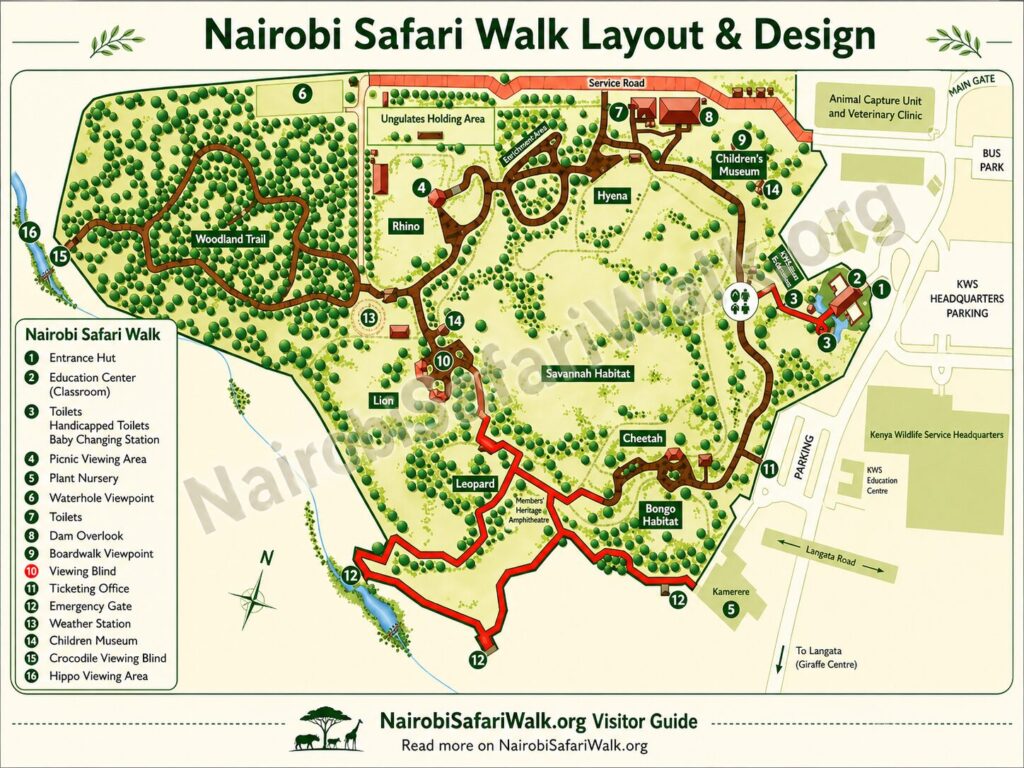
The Nairobi Safari Walk follows a compact, mostly continuous circuit through a series of wildlife enclosures and habitat zones. Visitors enter near the reception and ticketing area, join the main pedestrian trail and raised wooden boardwalk, then follow the route around the facility before returning toward the exit. It is designed as a self-guided walking experience, so you do not need a safari vehicle or a complicated route plan.
The route is best understood as an interpretation of Kenya’s principal ecosystems rather than simply a line of animal enclosures. The boardwalk passes through landscapes representing wetland, savannah and forest habitats, allowing visitors to observe how animals, birds, vegetation and water systems are connected. Kenya Wildlife Service describes the elevated boardwalk as providing views over wildlife habitats, the rocky landscape and the Mokoyet River environment.
How the walking route works
From the entrance, visitors proceed onto the principal pathway and follow the natural flow of the boardwalk around the animal and habitat exhibits. Directional signs and identification boards help explain the species and ecosystems encountered along the way.
The experience generally unfolds in four parts:
- Entrance and route orientation
After ticket verification, visitors join the main walkway. This is a good place to check the facility layout, organize children or school groups and identify any exhibits that are temporarily closed. - Main wildlife-viewing circuit
The route passes the principal animal habitats. Depending on the animals currently present and their visibility, visitors may encounter species such as lions, cheetahs, leopards, rhinos, zebras, bongos, colobus monkeys and pygmy hippos. These are managed wildlife habitats, so a species may be resting, sheltering or temporarily out of view. - Raised boardwalk and ecosystem sections
Elevated sections provide a broader view across the surrounding vegetation and enclosures. The height of the boardwalk makes it easier to observe wildlife without standing directly against enclosure barriers. It also introduces the wetland, open savannah and wooded habitats represented within the facility. - Interpretation areas and return to the exit
The final part of the circuit continues past indigenous plants, birds, insects and conservation displays before guiding visitors back toward the entrance and exit area. Families and school groups should leave time for the identification boards and educational exhibits rather than treating this section as merely the way out.
Is the route a loop?
The route operates largely as a guided circuit, with connected walkways bringing visitors around the exhibits and back toward the exit. Although there may be short connecting paths or places where visitors can pause, the easiest approach is to follow the established direction of movement instead of trying to jump between individual animals.
The layout map should therefore be treated as an orientation guide, not a promise that animals will appear in a particular order. Enclosure access, maintenance work, animal welfare requirements and temporary diversions can alter the visitor flow.
Distance, terrain and walking time
Nairobi Safari Walk is relatively compact, but the visit involves continuous walking, standing and stopping at viewing points.
| Visiting style | Recommended time |
|---|---|
| Fast highlights walk | 45–60 minutes |
| Comfortable first visit | 1½–2 hours |
| Families, schools or photographers | 2–3 hours |
The walking surface combines constructed pathways and raised boardwalk sections. It is considerably easier than a wilderness hike and does not require specialist hiking equipment, but comfortable closed shoes are advisable. Families using pushchairs and visitors with limited mobility should ask staff about the most accessible route and whether any boardwalk section is temporarily restricted.
Best way to experience the route
Walk slowly and treat each habitat as an observation point rather than rushing from one well-known animal to another. Predators may be inactive during warmer periods, while birds, primates and smaller species can reward visitors who stop, remain quiet and look beyond the most obvious enclosure areas.
For the most rewarding visit:
- Start during the cooler morning hours when possible.
- Allow at least 90 minutes for the full circuit.
- Carry drinking water, sun protection and a light rain layer.
- Read the habitat and species-identification signs.
- Keep children close on the boardwalk.
- Do not feed, call to or attempt to attract the animals.
- Avoid blocking narrow viewing sections when visiting as a group.
- Use binoculars for birds and animals resting farther from the walkway.
Nairobi Safari Walk is not a walking safari through the open Nairobi National Park. It is a controlled conservation-education facility where visitors remain on designated paths and boardwalks while viewing wildlife in managed habitats. Its value lies in providing close observation, ecosystem interpretation and an accessible introduction to Kenyan wildlife—especially for families, schools and visitors who cannot undertake a full game drive. Most visitors should reserve 1½ to 2 hours to complete the route comfortably.