
Nairobi Safari Walk is a walk-through wildlife and conservation attraction on Lang’ata Road, about 8 km from Nairobi CBD, beside the Nairobi National Park/KWS headquarters area. It is built around a raised wooden boardwalk that passes through simulated wetland, savannah and forest habitats, giving you close but safe views of animals, birds, insects, indigenous trees and habitat displays.
For families, school groups, first-time visitors and travelers with limited time in Nairobi, it is one of the easiest ways to experience Kenya’s wildlife without committing to a full game drive. For a deeper planning overview, start with our complete Nairobi Safari Walk visitor guide.
NairobiSafariWalk.org is an independent visitor guide created to help travelers, Nairobi residents, families, schools and tour planners understand what Nairobi Safari Walk is, how to visit, what it costs, what animals to expect, and how it compares with nearby attractions such as Nairobi National Park, Nairobi Animal Orphanage, Giraffe Centre and Sheldrick Wildlife Trust.
Plan Your Nairobi Safari Walk Visit
Use this homepage as your main hub, then follow the detailed guides for fees, animals, directions, family visits, nearby attractions and private visit planning.
Quick Visitor Summary
| Visitor Question | Short Answer |
|---|---|
| What is Nairobi Safari Walk? | A KWS wildlife, boardwalk and conservation education facility near Nairobi National Park. |
| Where is it? | Lang’ata Road, about 8 km from Nairobi CBD, slightly past Langata Army Barracks. See the location and map guide. |
| What is the main experience? | Walking along a raised wooden boardwalk with views of wildlife, habitats and interpretation displays. |
| Is it a game drive? | No. It is a walking wildlife attraction, not an open-range vehicle safari. Compare it with a game drive in our Nairobi Safari Walk vs Nairobi National Park guide. |
| Who is it best for? | Families, children, school groups, first-time visitors, photographers and travelers short on time. |
| Can you see animals? | Yes. KWS lists wildlife including cheetah, lion, leopard, pygmy hippo, zebra, colobus monkey, bongo and rhino. See our Nairobi Safari Walk animals guide. |
| How do you pay? | KWS lists payment through eCitizen using M-Pesa or Visa card. Check our fees and tickets guide. |
| Is there a vehicle entry fee? | No vehicle entry charge applies because the facility is designed for walking. |
| When should you go? | KWS lists it as suitable all year round; mornings are usually more comfortable for walking. See the best time planning guide. |
| Can it be combined with other attractions? | Yes. It pairs well with Nairobi Animal Orphanage, Nairobi National Park, Giraffe Centre, Sheldrick and Bomas. Use our nearby attractions guide. |
What Is Nairobi Safari Walk?
Nairobi Safari Walk is a Kenya Wildlife Service facility designed as both a visitor attraction and a conservation education space. KWS describes it as a place where visitors can experience three simulated ecosystems: wetland, savannah and forest. The raised wooden boardwalk gives uninterrupted views of animals, wildlife habitats, River Mokoyet and the rocky thickets of Nairobi National Park.
The easiest way to think about Nairobi Safari Walk is this: it is not a wild game drive, and it is not a normal zoo either. It is a structured wildlife walk where animals are viewed from safe distances, with interpretation boards and habitat-style enclosures helping visitors learn what they are seeing. KWS specifically notes that the wildlife exhibits are designed to give close views at a safe distance, with identification boards offering more information about the animals.
For a Nairobi visitor, the value is convenience. You can see big cats, rhino, antelopes, primates, birds, insects, trees and habitat displays in a compact area without needing several hours inside the main national park.
Read the complete visitor guide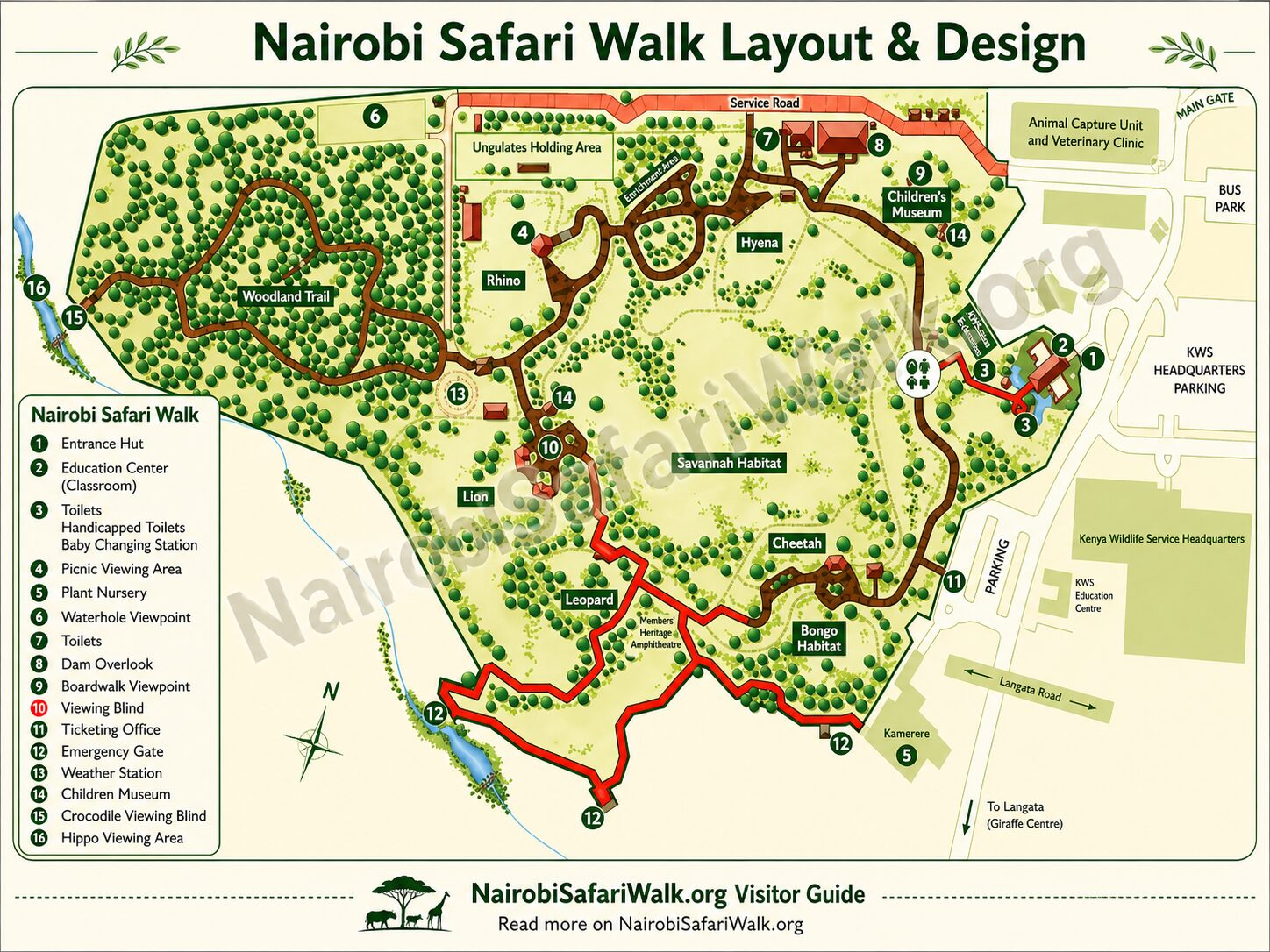
Why Visit Nairobi Safari Walk?
Visit Nairobi Safari Walk if you want a short, accessible wildlife experience in Nairobi that works for children, first-time safari travelers, students and visitors who may not have time for a full Nairobi National Park game drive.
The site stands out because it combines four things in one place:
- Wildlife viewing from a raised boardwalk
- Conservation education for schools, students and the general public
- Habitat interpretation through wetland, savannah and forest sections
- Easy city access from Lang’ata Road and central Nairobi
KWS describes Nairobi Safari Walk as a conservation education hub for schools, higher learning institutions and the general public, with an education role aimed at encouraging public participation in wildlife conservation. It also notes that the facility acts as a wildlife research center, especially for students and learning institutions.
That makes it especially strong for visitors who want more than a photo stop. Children can see animals closely, students can connect wildlife to conservation, and tourists can get an introduction to Kenya’s ecosystems before visiting larger parks such as Maasai Mara, Amboseli, Samburu or Tsavo.
Families
Use the family visitor guide if you are planning with children, toddlers or mixed-age visitors.
Schools
Use the school trip and conservation education guide for group learning ideas.
Private visits
Use the private visits guide if you want transfers, timing support or a planned Nairobi outing.
Where Is Nairobi Safari Walk Located?
Nairobi Safari Walk is located on Lang’ata Road, about 8 km from Nairobi Central Business District. KWS describes the route as easily accessible from Nyayo National Stadium through Lang’ata Road, slightly past the Langata Army Barracks.
For local directions, most Nairobi drivers understand the destination better when you mention KWS headquarters on Lang’ata Road or Nairobi National Park main gate area. If you are using a ride-hailing app, check that the pin leads to Nairobi Safari Walk or KWS headquarters rather than deep into Nairobi National Park.
For detailed route planning, use our Nairobi Safari Walk location, map and directions guide or the practical how to get to Nairobi Safari Walk guide.
Common routes
| Starting Point | Visitor Planning Note |
|---|---|
| Nairobi CBD | Usually the simplest city route is via Uhuru Highway, Mbagathi Way or Lang’ata Road depending on traffic. |
| Wilson Airport | Very convenient because Wilson is on the southern side of Nairobi, relatively close to Lang’ata Road. |
| JKIA | Possible as a short Nairobi stop, but allow traffic and airport buffer time. See the JKIA layover guide. |
| Karen | Easy to combine with Giraffe Centre, Karen Blixen Museum or lunch in Karen. |
| Westlands | Allow extra time because cross-city traffic can be slow, especially during peak hours. |
Nairobi Safari Walk Entry Fees and Payment
KWS lists Nairobi Safari Walk entry fees by visitor category, with payment through eCitizen using M-Pesa or Visa card. Because KWS fees can change through official tariff updates, always confirm the current amount on the KWS or eCitizen payment platform before traveling.
Use our detailed Nairobi Safari Walk entry fees and tickets guide before you visit. You can also compare updates in the new entry fees guide.
| Visitor Category | Adult | Child |
|---|---|---|
| East African Citizen | KSh 300 | KSh 200 |
| Resident | KSh 405 | KSh 300 |
| Non-Resident | USD 25 | USD 15 |
| African Citizen | USD 15 | USD 10 |
KWS also notes that vehicle charges do not apply at Nairobi Safari Walk because the facility is for walking.
What Animals Can You See at Nairobi Safari Walk?
Nairobi Safari Walk is designed to showcase a sample of Kenya’s wildlife in a compact, accessible setting. KWS lists wildlife including cheetah, lion, leopard, pygmy hippo, zebra, colobus monkey, bongo and rhino, and also notes a wide variety of birds and insects.
KWS also highlights white rhino, big cats, crocodiles, pygmy hippo, antelopes and primates as part of the fauna visitors may encounter at the Safari Walk. For a fuller species-focused page, read our animals at Nairobi Safari Walk guide.
Wildlife highlights
| Wildlife Group | Examples Visitors May Look For | Visitor Expectation |
|---|---|---|
| Big cats | Lion, cheetah, leopard | Usually among the most exciting stops for children and first-time visitors. |
| Large mammals | Rhino, zebra, pygmy hippo | Good for close viewing and conservation interpretation. |
| Antelopes | Bongo and other antelope species | Useful for learning about Kenya’s lesser-known wildlife. |
| Primates | Colobus monkey and other primates | Often appealing for families and school groups. |
| Reptiles | Crocodiles | A strong teaching point for wetland and river habitats. |
| Birds and insects | Various species around the habitats | Bring binoculars if you enjoy birding or nature details. |
A local tip: do not go expecting the same feeling as a lion sighting on a wild game drive. Nairobi Safari Walk is a close-viewing education experience. Nairobi National Park is the better choice if your main goal is open-range safari movement, tracking and the possibility of wild predator encounters.
For the deeper comparison, read captive game viewing at Nairobi Safari Walk vs game viewing in the wild at Nairobi National Park.
The Boardwalk Experience
The boardwalk is the signature feature of Nairobi Safari Walk. KWS describes it as a raised wooden boardwalk that snakes around the ecosystem and allows uninterrupted views of the animals and varied habitats.
This is what makes the place easy for visitors. You follow a defined route, pause at viewing points, read signs, watch animals from safe distances and move at your own pace. It is especially good for children because the route feels adventurous without the pressure of a long hike.
The experience is usually strongest when you slow down. Many visitors rush to the big cats and miss the habitat story. The wetland, savannah and forest sections are part of the attraction, not just the spaces between animal enclosures.
Read “A Walk on the Wild Side”Is Nairobi Safari Walk Good for Kids?
Yes. Nairobi Safari Walk is one of the better wildlife stops in Nairobi for children because it is short, walkable, educational and visually engaging. KWS lists a Children’s Museum among the key features, and also describes the facility as a conservation education hub for schools and the public.
For families, the main advantage is that children can see animals without spending hours in a vehicle. The route is also easier to manage than a full-day safari if you have toddlers, young children or visitors who may get tired quickly. For detailed family planning, use the Nairobi Safari Walk with kids guide.
Tips for families
- Go in the morning if possible, especially with toddlers.
- Carry drinking water, hats and sunscreen.
- Give children a simple animal checklist before you start.
- Pause at interpretation boards rather than rushing through.
- Combine it with one nearby attraction only if your children still have energy.
KWS recommends visitors bring personal effects, drinking water, a camera, binoculars, sunscreen, insect repellant, first aid kit and bird identification material if needed.
Best Time to Visit Nairobi Safari Walk
KWS lists Nairobi Safari Walk as a place to visit all year round. The official page also describes Nairobi’s seasonal pattern as hot and dry from January to March, hot and wet from April to June, and very warm and wet from July to October.
For comfort, the best time is usually morning, especially for families, school groups and visitors who want cooler walking conditions. Afternoon visits can still work, but the light can be harsher and children may tire faster. Compare timing options in the opening hours and best time guide.
Suggested timing
| Visitor Type | Best Timing | Why |
|---|---|---|
| Families with children | Morning | Cooler, easier walking and better energy levels. |
| Photographers | Morning or late afternoon | Softer light and better comfort. |
| School groups | Morning | Easier supervision and more time for learning. |
| Tourists combining attractions | Morning or early afternoon | Leaves time for Giraffe Centre, Animal Orphanage or Bomas. |
| Short-stay visitors | Any daytime window with enough buffer | Works well as a compact Nairobi activity. |
How Long Does Nairobi Safari Walk Take?
Most visitors should allow 1.5 to 2 hours for Nairobi Safari Walk. A fast visitor can move through more quickly, but the experience is better when you pause at the animal enclosures, read the signs, take photos and give children time to observe.
For a homepage visitor guide, the safest planning range is:
- 45–60 minutes: rushed visit, mainly to see highlights
- 1.5–2 hours: comfortable visit for most travelers
- 2–3 hours: slower family, school, photography or birding visit
If you are combining it with Nairobi Animal Orphanage or Giraffe Centre, plan the day as a half-day outing rather than trying to squeeze too many stops into two hours. Use the Nairobi Safari Walk itinerary guide to choose a realistic route.
What to Carry
For a smooth visit, carry light but practical items. KWS specifically recommends drinking water, camera, binoculars, sunscreen, insect repellant, first aid kit and bird identification material where relevant.
Visitor checklist
- Comfortable walking shoes
- Drinking water
- Hat or cap
- Sunscreen
- Light rain jacket during wet months
- Camera or phone with enough battery
- Binoculars for birds and distant animals
- Insect repellent
- Small notebook or animal checklist for children
- M-Pesa or card payment readiness for eCitizen
Avoid carrying too much. This is a walking attraction, so the best setup is a small day bag, not heavy safari luggage.
Nairobi Safari Walk vs Nairobi National Park
Nairobi Safari Walk and Nairobi National Park are related but very different visitor experiences.
Nairobi Safari Walk is a walking, boardwalk-based, close-viewing conservation facility. Nairobi National Park is a full national park safari experience where visitors enter by vehicle and search for wildlife across open habitats. KWS lists Nairobi National Park separately as a wildlife park about 10 km from Nairobi city centre, with game viewing, picnic, camping, scenic and other activities.
Use our detailed comparison of Nairobi Safari Walk vs Nairobi National Park if you are deciding between the two.
| Comparison Point | Nairobi Safari Walk | Nairobi National Park |
|---|---|---|
| Main format | Walking boardwalk | Vehicle game drive |
| Wildlife setting | Managed exhibits and habitat displays | Open-range national park |
| Time needed | Usually 1.5–2 hours | Half-day to full-day |
| Best for | Kids, schools, short visits, learning | Real safari, photography, wild animal movement |
| Predator experience | Close but managed viewing | Wild sightings, not guaranteed |
| Cost level | Lower entry cost | Higher park entry and vehicle/tour cost |
| Ease of visit | Simple and compact | Needs more planning and time |
Choose Nairobi Safari Walk if you want an easy, educational wildlife stop. Choose Nairobi National Park if you want the fuller safari experience.
Nairobi Safari Walk and Nearby Attractions
Nairobi Safari Walk sits in one of Nairobi’s best areas for wildlife, culture and family attractions. It pairs naturally with Nairobi Animal Orphanage, Nairobi National Park, Giraffe Centre, Sheldrick Wildlife Trust, Bomas of Kenya, Karen Blixen Museum and local restaurants around Lang’ata and Karen.
Use the Nairobi Safari Walk combined with nearby attractions guide or the broader Safari Walk vs Animal Orphanage vs Sheldrick vs Giraffe Centre guide before building your day plan.
Easy attraction pairings
| Combination | Best For | Planning Note |
|---|---|---|
| Safari Walk + Animal Orphanage | Families and school groups | Very convenient because both are in the same general KWS/Nairobi National Park area. Read whether you should visit both Safari Walk and Animal Orphanage. |
| Safari Walk + Nairobi National Park | Wildlife-focused visitors | Do the park game drive first, then Safari Walk if energy allows. |
| Safari Walk + Giraffe Centre | Families and first-time tourists | Giraffe Centre is open daily from 9 AM to 5 PM, including weekends and public holidays. |
| Safari Walk + Sheldrick | Elephant lovers | Sheldrick’s public visit is strictly 11 AM to 12 noon and requires advance booking. |
| Safari Walk + Bomas of Kenya | Culture and wildlife day | Good for visitors who want wildlife first and cultural performance later. |
| Safari Walk + Carnivore | Easy lunch or dinner add-on | Works well after a morning or afternoon visit. See also the food and refreshments guide. |
A very workable local plan is: Nairobi National Park morning game drive, then Nairobi Safari Walk, then lunch in Karen or Lang’ata. For families, a gentler option is Nairobi Safari Walk + Giraffe Centre without adding too many stops.
Can You Visit Nairobi Safari Walk on a Layover?
Yes, but only with enough time. Nairobi Safari Walk can work for a Nairobi layover because it is compact and close to the Lang’ata attraction circuit, but JKIA traffic can be unpredictable. If your layover is short, do not risk it. If you have a long daytime layover, private transfer is safer than relying on last-minute taxis.
For JKIA visitors, the key question is not whether Safari Walk is worth it. The key question is whether you have enough buffer for immigration, baggage, traffic, security screening and return check-in. Use the dedicated Nairobi Safari Walk layover tour from JKIA guide before attempting this plan.
A safe layover plan should include:
- Confirmed arrival time
- Visa or entry requirements handled
- Private driver waiting at arrivals
- No checked luggage delays
- At least several hours free outside airport procedures
- A clear return-to-airport deadline
Is Nairobi Safari Walk Worth It?
Nairobi Safari Walk is worth visiting if you want a short, accessible, educational wildlife experience in Nairobi. It is especially worthwhile for families, children, students, first-time visitors and tourists who want to see animals without organizing a full safari.
It may not be the right choice if your main goal is a wild safari atmosphere, dramatic predator tracking, large herds in open plains or a full photographic game drive. In that case, Nairobi National Park is the stronger option.
Visit Nairobi Safari Walk if you want:
- A short wildlife activity in Nairobi
- A child-friendly outing
- Close views of animals from safe distances
- A low-stress introduction to Kenyan wildlife
- A conservation education stop
- A useful add-on before or after Nairobi National Park
Consider another attraction if you want:
- A full safari drive
- Wild animal tracking
- Elephant nursery experience
- Giraffe feeding interaction
- A purely cultural performance
- A full-day outdoor wilderness experience
Safety and Visitor Rules
Nairobi Safari Walk is designed for safe viewing, with animals seen from controlled viewing areas and the boardwalk. KWS notes that exhibits are designed to give close views at a safe distance.
Visitors should still behave responsibly. Do not feed animals, do not shout at them, do not cross barriers, and keep children close. This is a conservation facility, not a playground.
For more detail, read the safety regulations at Nairobi Safari Walk and the guide on how to visit Nairobi Safari Walk responsibly.
Simple visitor etiquette
- Keep noise low around animals.
- Do not feed or tease wildlife.
- Stay on visitor paths and boardwalk areas.
- Read animal signs before taking photos.
- Keep children supervised at all times.
- Carry out litter or use designated bins.
- Respect school groups and other families sharing the space.
Nairobi Safari Walk for Schools and Students
Nairobi Safari Walk is particularly strong as an educational destination. KWS identifies it as a conservation education hub for schools, higher learning institutions and the public, and notes its role as a wildlife research center especially for students and learning institutions.
Teachers can use the visit to introduce learners to:
- Kenyan ecosystems
- Wetland, savannah and forest habitats
- Predator and prey differences
- Threatened species and conservation
- Indigenous trees and habitat restoration
- Animal adaptation and behavior
- Human responsibility in wildlife protection
For school groups, the visit works best with a simple worksheet or checklist. Ask students to record three animals, three habitats, one conservation threat and one action they can take to protect wildlife. Use the full family, group, school trip and conservation education guide to plan the visit.
Suggested Nairobi Safari Walk Itineraries
Nairobi Safari Walk works best when you match the route to your time, group type and energy level. The four options below cover short visits, family visits, half-day wildlife plans and safari-focused combinations.
- Short Visit: 1.5 Hours
Start at the entrance, follow the boardwalk slowly, focus on the big cats, rhino, pygmy hippo, primates, birds and interpretation boards, then finish with photos and a short rest. This works for tourists with limited time. - Family Visit: 2 Hours
Arrive in the morning, move slowly with children, pause at each major animal stop, use the habitat displays as learning moments, then end with a snack or lunch nearby. - Half-Day Wildlife Plan
Start with Nairobi Safari Walk, add Nairobi Animal Orphanage, then continue to Giraffe Centre or lunch in Karen. This is a good family and first-time visitor circuit. - Safari-Focused Plan
Do Nairobi National Park early in the morning, then visit Nairobi Safari Walk afterward as a close-up wildlife and conservation education add-on. This works well when visitors want both wild safari and interpreted wildlife viewing.
For expanded route ideas, use the Nairobi Safari Walk itinerary guide or the Nairobi sanctuary package page.
Conservation, Captivity and Responsible Visiting
Nairobi Safari Walk is easiest to understand as a conservation education facility, not only as a place to see animals. The value of the visit increases when you read the signs, compare the habitats, and talk with children or students about why wildlife needs protection beyond enclosures and display areas.
For a deeper interpretation of this issue, read our guide to conservation and sustainability at Nairobi Safari Walk, the evidence-minded discussion on conservation and captivity at Nairobi Safari Walk, and the practical guide on how to visit Nairobi Safari Walk responsibly.
Frequently Asked Questions
Is Nairobi Safari Walk inside Nairobi National Park?
Nairobi Safari Walk is beside the Nairobi National Park/KWS headquarters area on Lang’ata Road, but it is a separate walk-through facility with its own visitor experience and entry fee. KWS lists Nairobi Safari Walk separately from Nairobi National Park and provides separate Safari Walk fees.
Can you see lions at Nairobi Safari Walk?
Yes. KWS lists lion among the wildlife at Nairobi Safari Walk, alongside cheetah, leopard, pygmy hippo, zebra, colobus monkey, bongo and rhino.
Is Nairobi Safari Walk good for children?
Yes. It is one of Nairobi’s easier wildlife attractions for children because the route is walkable, the viewing is close, and KWS lists a Children’s Museum and conservation education role.
How much is Nairobi Safari Walk?
KWS lists Nairobi Safari Walk fees as KSh 300 adult and KSh 200 child for East African citizens, KSh 405 adult and KSh 300 child for residents, USD 25 adult and USD 15 child for non-residents, and USD 15 adult and USD 10 child for African citizens. Check the Nairobi Safari Walk entry fees guide before traveling.
Can you pay cash at Nairobi Safari Walk?
KWS lists payment through eCitizen via M-Pesa or Visa card. Visitors should prepare for digital payment rather than assuming cash will be accepted.
Do vehicle entry charges apply?
No. KWS states that vehicle charges do not apply because the facility allows walking.
What should I carry?
Carry drinking water, comfortable shoes, sunscreen, insect repellent, a camera, binoculars and light personal items. KWS specifically recommends drinking water, camera, binoculars, sunscreen, insect repellant and first aid kit.
Is Nairobi Safari Walk worth visiting before a safari?
Yes, especially for first-time visitors. It gives a simple introduction to Kenyan wildlife, habitats and conservation before you travel to larger parks.
Is it worth visiting after Maasai Mara or Amboseli?
It depends. After a major safari, Nairobi Safari Walk will feel smaller and more controlled, but it can still be useful for children, education, close animal viewing and a relaxed final Nairobi activity.
More Nairobi Safari Walk Guides
These detailed pages support the homepage and help you plan a more specific visit.
Entry Fees & Tickets
Current fee categories, payment notes and ticket planning.
Animals Guide
Wildlife groups, visitor expectations and conservation framing.
Safari Walk vs Animal Orphanage
Choose the right KWS visitor facility for your group.
Animal Orphanage Entry Fees
Useful if you plan to combine both nearby KWS attractions.
Nearby Attractions
Giraffe Centre, Sheldrick, Bomas, Karen and lunch combinations.
JKIA Layover Visit
How to judge whether a layover visit is realistic and safe.
Food & Refreshments
Plan where to eat before or after the walk.
Safety Regulations
Rules, child supervision and responsible viewing behavior.
Our Takeaway
For most visitors, Nairobi Safari Walk works best as a half-day Nairobi wildlife stop, not as a rushed photo stop and not as a replacement for Nairobi National Park. Go with the right expectation: this is a curated walking wildlife and conservation experience. The joy is in the closeness, the boardwalk, the learning, the children’s reactions and the convenience of seeing a slice of Kenya’s wildlife without leaving the city.