
And what Nairobi Safari Walk gets right (and where the bar still is)
If you strip away the emotion and the marketing, conservation science doesn’t ask a simple question like “Are zoos good or bad?” It asks a harder one:
Does this specific captive facility measurably help wildlife in the wild—without compromising animal welfare?
That’s the standard used by the IUCN (the world’s main authority on conservation policy) and by researchers who study zoo and wildlife-education impacts. Nairobi Safari Walk sits in a special category—closer to an interpretive conservation walk than a traditional zoo—so it’s a useful case study for what modern science actually supports.
1) First, the big rule: Captivity is a tool, not the goal
The IUCN’s guidance on ex situ conservation (that’s conservation outside the wild) is very direct:
- Captive populations are not a replacement for protecting habitats.
- They are support tools for:
- research
- education
- insurance populations
- reintroduction or recovery programs
- They should be integrated with wild conservation plans, not run in isolation.
In other words, science says captivity is only justified when it serves real in-situ conservation outcomes.
Key takeaway: If a facility can’t show how it helps wildlife in the wild, its conservation claims are weak.
Read more:
- IUCN Ex Situ Guidelines (PDF): https://portals.iucn.org/library/efiles/documents/Rep-2002-017.pdf
2) Animal welfare is not optional—it’s the foundation
There’s a large body of research on the visitor effect—how people affect animals in captive settings.
What studies consistently find:
- High noise, crowding, and unpredictable behavior can increase stress and avoidance behavior in many species.
- Calm, predictable environments with controlled viewing distances can support more natural behavior.
- Poor visitor management can quietly turn an “educational” exhibit into a chronic stress environment.
A major review by Sherwen & Hemsworth (2019) shows that visitor presence can be positive, neutral, or negative depending on design and management—and that facilities must actively manage crowds, noise, and behavior to protect welfare.
Key takeaway: Any conservation or education claim collapses if welfare is compromised.
Read more:
- Sherwen & Hemsworth (2019), Animals journal: https://www.mdpi.com/2076-2615/9/6/366
- Hosey (2000), Animal Welfare: https://www.cambridge.org/core/journals/animal-welfare/article/zoo-animals-and-their-human-audiences-what-is-the-visitor-effect/6CE49F16509D20BCF7A9408678F345B0
3) Does conservation education in zoos and wildlife parks actually work?
This is where the science gets interesting—and more honest.
Recent reviews and meta-analyses show:
- Visiting zoos and aquariums can improve:
- knowledge
- attitudes toward conservation
- concern for wildlife
- sometimes intentions to act
- But:
- Effects are variable
- Many programs don’t measure real outcomes
- “Awareness” alone does not reliably change behavior
A 2024 meta-analysis (McNally et al.) found that visits do have measurable positive effects, but the size and durability of those effects depend heavily on how education is designed and evaluated.
Key takeaway: Education works best when it’s:
- goal-driven
- measured
- linked to specific behaviors (not just “raising awareness”)
4) Where captive facilities really help: research and species recovery
Captive and managed populations have played real roles in:
- breeding and genetic management
- veterinary and reproductive research
- preparing animals for reintroduction
- holding “insurance populations” for critically endangered species
But the IUCN and conservation planners are clear: these only make sense when they are part of a species-level plan that prioritizes wild populations first.
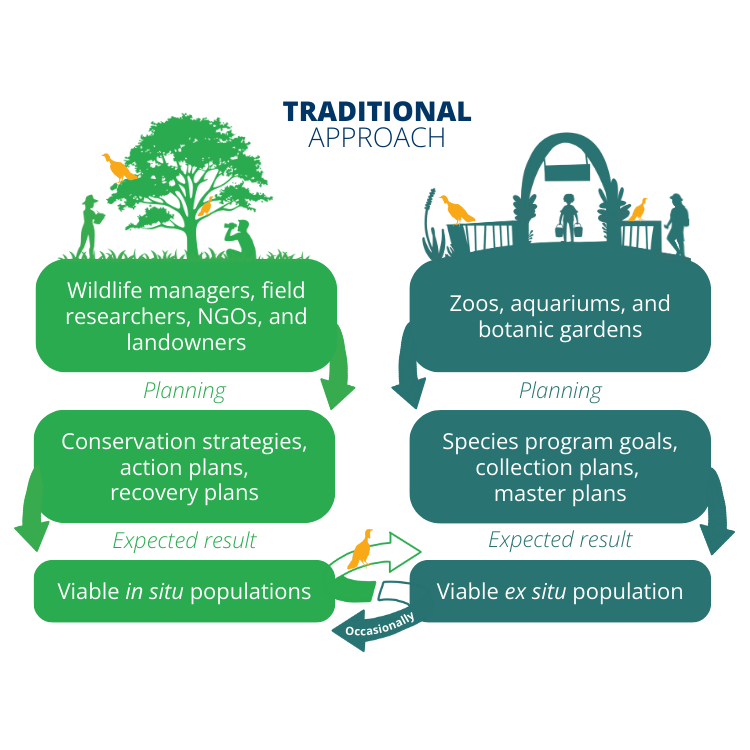
This is exactly what the One Plan Approach is about: managing wild and captive populations together, not as separate worlds.
Key takeaway: Captivity is strongest when it’s a support system, not a showcase.
Read more:
- CPSG One Plan Approach: https://www.cpsg.org/our-work/our-approach/one-plan-approach
- IUCN SSC Conservation Planning: https://www.iucn.org/our-work/species/conservation-planning
5) The main criticisms—and why scientists take them seriously
Researchers and conservationists often raise four big concerns:
- Distraction risk: Charismatic exhibits can pull money and attention away from habitat protection.
- Welfare risks: Poorly designed visitor experiences create chronic stress for animals.
- Overstated education claims: Many places claim impact without measuring it.
- Normalizing spectacle: Wildlife can become entertainment rather than a conservation responsibility.
These aren’t ideological arguments—they come directly from welfare science and education research.
Key takeaway: Captive conservation must constantly justify itself with evidence, not just good intentions.
Read more:
- Sherwen & Hemsworth (2019): https://www.mdpi.com/2076-2615/9/6/366
- IUCN Ex Situ Guidelines: https://portals.iucn.org/library/efiles/documents/Rep-2002-017.pdf
6) So where does Nairobi Safari Walk fit into all this?
Nairobi Safari Walk is not designed like a classic city zoo. Its walking trail, habitat zones, and interpretation focus place it closer to an educational conservation exhibit than a collection of cages.
Kenya Wildlife Service describes it as:
- a conservation education hub
- a learning and research center for students and institutions
That positioning matters, because science says the format that works best is one that:
- controls visitor flow and noise
- keeps predictable viewing distances
- emphasizes ecosystems and threats, not just animals
- links learning to real conservation issues
Potential advantages over traditional zoos:
- Better crowd and movement control (reduces visitor-effect stress)
- Stronger ecological storytelling (not just species display)
- Clearer education mission tied to Kenya’s conservation context
But here’s the scientific condition:
It only earns that advantage if it:
- actively protects animal welfare
- measures education outcomes
- shows real links to wider conservation work
Read more:
- Kenya Wildlife Service – Nairobi Safari Walk: https://www.kws.go.ke/nairobi-safari-walk
- Visitor effect research: https://www.mdpi.com/2076-2615/9/6/366
7) Is the Safari Walk model “better” than zoos, according to science?
The honest scientific answer is: It can be—but only if it’s done properly.
- Better than entertainment-focused zoos? Yes, in principle, because it prioritizes context and learning.
- Better than protecting real habitats? No—nothing replaces in-situ conservation.
- Better as a public education tool in a city? Often yes, because it reaches people who will never go on a remote safari.
Science doesn’t judge by labels (“zoo” vs “safari walk”). It judges by function:
- Are animals doing well?
- Are visitors learning something that changes behavior?
- Is this linked to real conservation outcomes?
Read more:
- One Plan Approach: https://www.cpsg.org/our-work/our-approach/one-plan-approach
8) The bottom line: what science actually supports
Science does not say:
- Captive wildlife is automatically good for conservation
- Or that all zoos and wildlife parks are harmful
Science does say:
- Welfare is non-negotiable
- Education must be measured, not assumed
- Captivity must serve wild conservation, not replace it
- Integrated, well-designed, welfare-first models can be powerful tools
In that light, Nairobi Safari Walk represents a modern, defensible direction for captive conservation—if it keeps proving, with data and practice, that it delivers real conservation value beyond the fence.